Projects
Explore my portfolio of projects across different technologies.
A Crack-Detection Wall-Climbing Robot
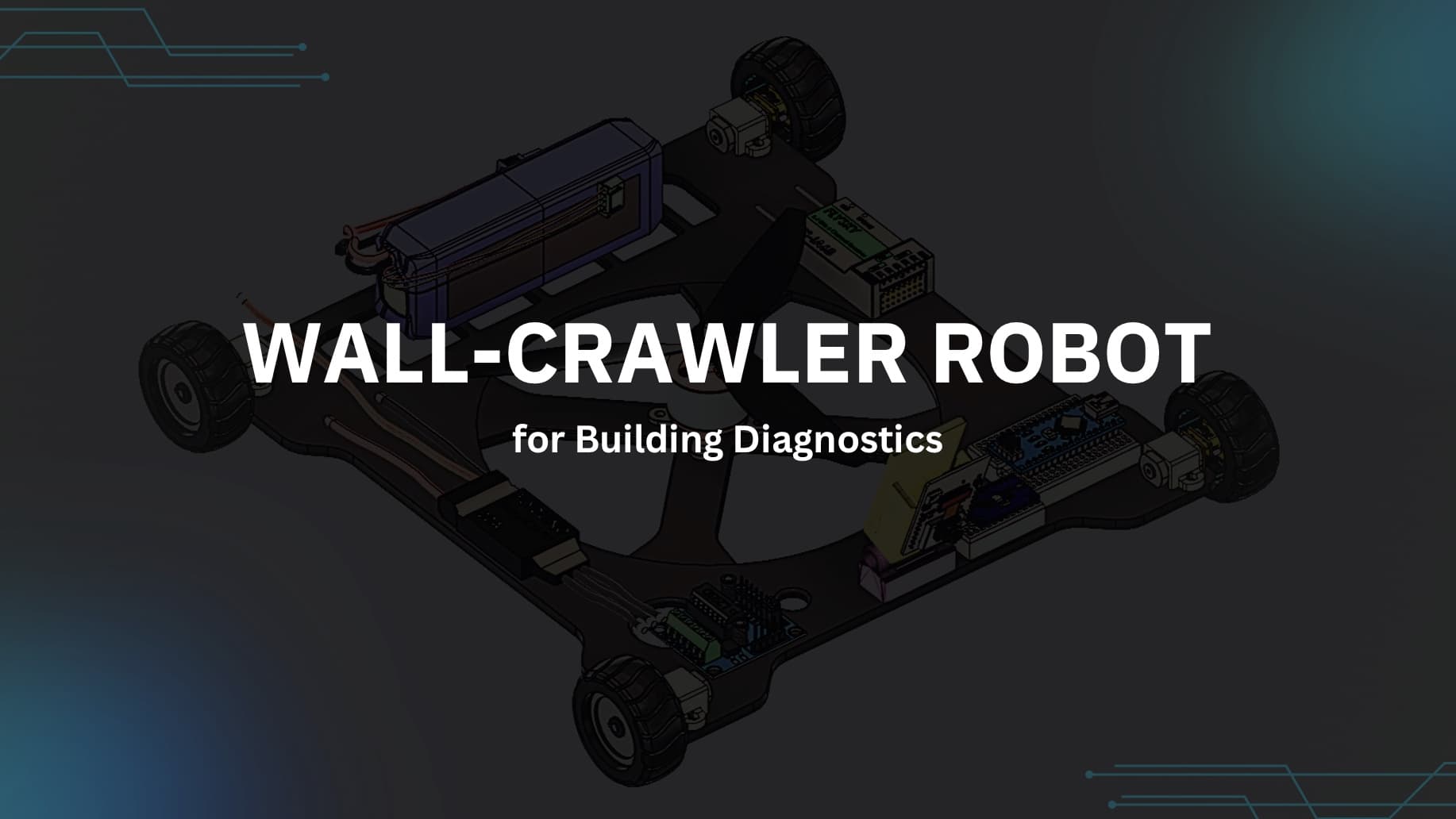

Mechatronics capstone — an autonomous robot that climbs vertical building surfaces using propeller-based adhesion, streams live images to a Django server, and classifies structural cracks in real time using a TensorFlow model.
┌─────────────┐   I2C    ┌─────────────────┐
│   MPU9250   │──────────►                 │
│  9-DOF IMU  │          │  Arduino Nano   │
├─────────────┤   I2C    │                 │  UART "IMU_roll_pitch_yaw_elev"
│   BMP280    │──────────►                 │──────────────────────────────────►
│  Altimeter  │          └─────────────────┘                                  │
└─────────────┘                                                                ▼
                                                                    ┌──────────────────┐
                                                                    │   ESP32-CAM      │
                                                                    │   WiFi + Camera  │
                                                                    └────────┬─────────┘
                                                                             │
                                                              HTTP POST /upload/
                                                              filename: IMU_-2.3_88.1_0.0_124.jpg
                                                                             │
                                                                             ▼
                                                                ┌────────────────────────┐
                                                                │      Django Server     │
                                                                │                        │
                                                                │  captured_images/      │
                                                                │         │              │
                                                                │  AI Thread (5s poll)   │
                                                                │  TensorFlow Keras      │
                                                                │  120×120 RGB           │
                                                                │         │              │
                                                                │  ┌──────┴──────┐      │
                                                                │  │             │      │
                                                                │crack_images/ no_crack/ │
                                                                │                        │
                                                                │  Bootstrap Gallery     │
                                                                │  (auto-refresh 2s)     │
                                                                └────────────────────────┘
The Arduino Nano reads an MPU9250 (roll, pitch, yaw) and a BMP280 (relative altitude). Orientation uses a complementary filter — gyroscope integration corrected by the accelerometer on every tick.
// Complementary filter — blends gyro integration with accel-derived angle
const float alpha = 0.96f;
roll  = alpha * lastRoll  + (1.0f - alpha) * accelRoll;
pitch = alpha * lastPitch + (1.0f - alpha) * accelPitch;
Every 2 seconds, the Arduino formats all four values into a single UART string and sends it to the ESP32-CAM:
IMU_<roll>_<pitch>_<yaw>_<elevation>

Example:  IMU_-2.3_88.1_0.0_124
Rather than making a separate API call for metadata, the sensor string becomes the JPEG filename. The ESP32-CAM captures a frame and POSTs it with that name:
POST /upload/ HTTP/1.1
Content-Type: multipart/form-data; boundary=dataMarker

--dataMarker
Content-Disposition: form-data; name="imageFile";
                     filename="IMU_-2.3_88.1_0.0_124.jpg"
Content-Type: image/jpeg
[JPEG binary — streamed in 1024-byte chunks]
Django's gallery view recovers the sensor values with a single split — no database joins needed:
def parse_image_data(filename):
    data = filename.replace('IMU_', '').replace('.jpg', '').split('_')
    return {
        'roll':      float(data[0]),
        'pitch':     float(data[1]),
        'yaw':       float(data[2]),
        'elevation': float(data[3])
    }
A TensorFlow inference thread starts automatically when Django boots — no manual management needed:
# apps.py — fires once on startup
class CameraAppConfig(AppConfig):
    def ready(self):
        import os
        if os.environ.get('RUN_MAIN', None) != 'true':
            thread = threading.Thread(target=ai_monitoring.start_monitoring)
            thread.daemon = True
            thread.start()
The monitoring loop runs every 5 seconds:
captured_images/*.jpg
        │
        ▼  ImageDataGenerator(rescale=1./255)
        │  flow_from_dataframe(target_size=(120,120), color_mode='rgb')
        │
        ▼  model.predict()
        │
        ├── score > 0.5  ──►  crack_images/
        └── score ≤ 0.5  ──►  no_crack_images/
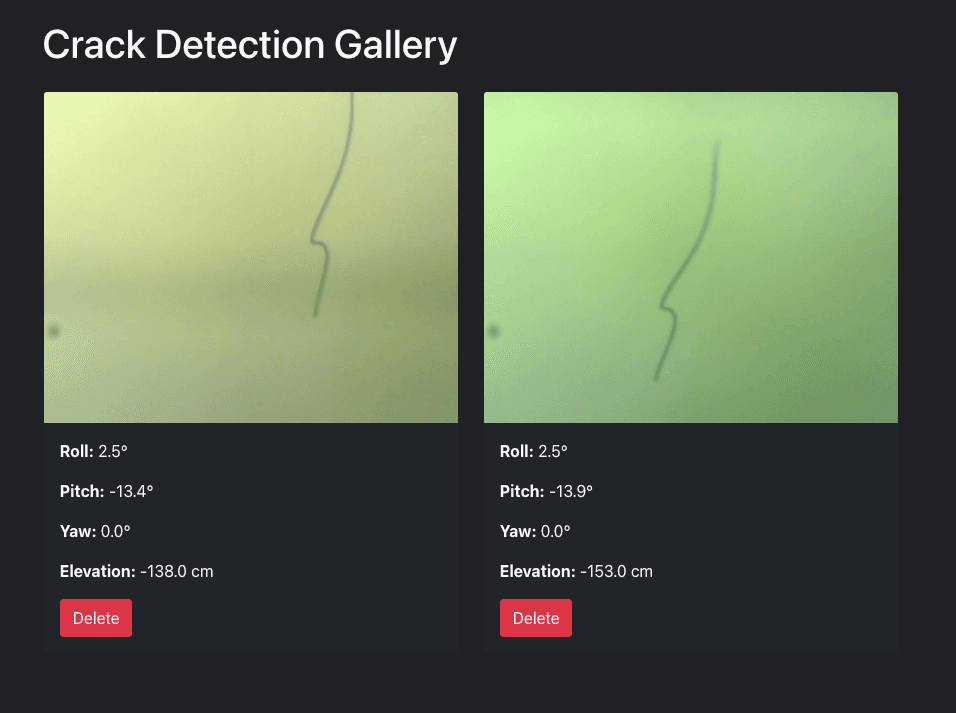
The frontend auto-refreshes without WebSockets: jQuery polls /count-photos/ every 2 seconds and re-fetches the HTML fragment only when the count changes. Each card renders all four sensor fields parsed from the filename.
Before finalizing hardware gains, I simulated the wall-angle transition (0° horizontal → 90° vertical) in Python. The controller output scales motor thrust based on angle error.
class WallCrawlerController:
    # Robot: 650 g, friction μ = 0.6, max thrust = 13 N
    def calculate_required_thrust(self, angle_deg):
        angle = np.radians(angle_deg)
        mg    = self.mass * self.g
        return mg * np.sin(angle) * np.sqrt(1 + self.friction_coef**2) * 1.2
Simulation results — four gain combinations:
| Kp | Ki | Kd | Steady-State Error |
|---|---|---|---|
| 1.8 | 0.12 | 0.35 | 4.43° |
| 2.0 | 0.10 | 0.40 | 4.23° |
| 1.5 | 0.08 | 0.30 | 4.48° |
| 1.2 | 0.05 | 0.25 | 4.35° |
| Part | Role |
|---|---|
| Arduino Nano | Sensor reading + UART trigger |
| MPU9250 | Roll / pitch / yaw (9-DOF IMU) |
| BMP280 | Relative altitude in cm |
| ESP32-CAM | JPEG capture + WiFi HTTP POST |
| Propeller motors | Negative-pressure wall adhesion |
| Drive motors | Directional movement on surface |